August 19, 2026
The Hidden Psychology of Sound Design

Motion
6 minutes read
Felt, not heard
How we think about sound design in Motion.
Nobody rewinds a video to hear the sound design.
That's the point. When it's right, you can't name a single sound in the film. You just walk away thinking it felt expensive. When it's wrong, you know in two seconds.
So the first rule we hold at Motion is simple. The best sound design is felt, not heard.
But why does that work on us? To answer that, we need to look at actual human behavior: what makes a human like something, and why.
Let's dive into it :)
Sound is faking familiarity
Here's the philosophical core of it.
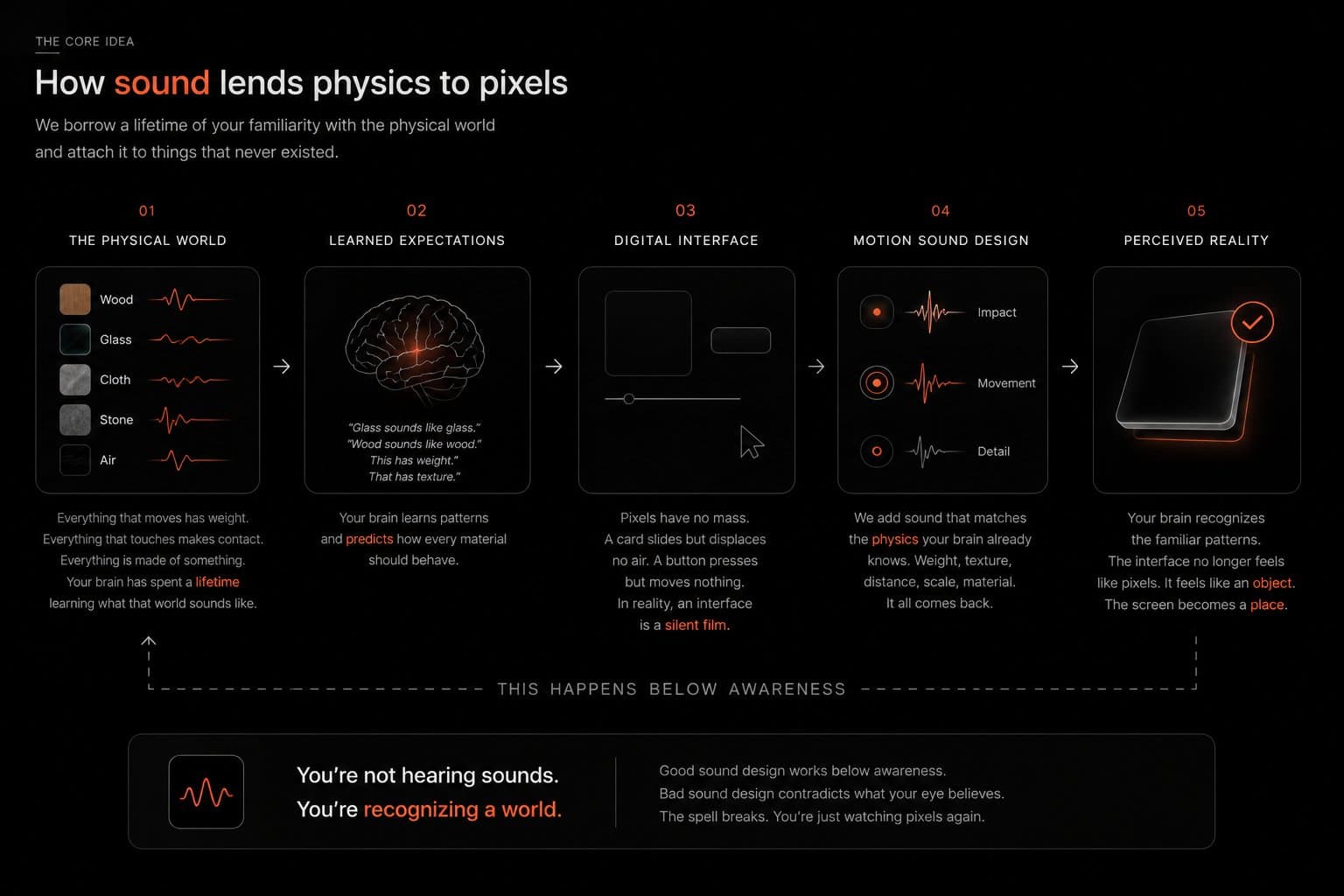
Your ear didn't grow up on screens. It grew up in a world where everything that moves has weight, everything that touches makes contact, and everything is made of something. Wood, cloth, glass, air. You've spent your whole life learning what that world sounds like. You don't think about it. It's just how reality confirms itself.
Pixels have none of that. A card sliding across a screen displaces zero air. A button press moves nothing. In reality, an interface is a silent film
Sound design is how we lend physics back to the pixels. When a panel lands with a soft low thump, your brain doesn't process it as "a sound effect was added here." It processes it as that thing has weight. The rectangle becomes an object. The screen becomes a place.
So we're not really designing sounds. We're borrowing a lifetime of your own familiarity with the physical world and quietly attaching it to things that never existed. That's why good sound design works below awareness. You're not hearing sounds, you're recognizing a world. And that's also why bad sound design fails so hard: the moment a sound contradicts what your eye believes, the spell breaks and you're just watching pixels again.
Everything else we do follows from that one idea.
A sound exists to confirm what the eye already believes
A sound is never decoration. It has a job, and there are basically three.
A riser predicts something, and it has to end exactly at the payoff. A whoosh moves your attention from one place to another. An impact lands the thing that was moving.
Everything else, the ticks and pops and textures, only comes after those three jobs are done right. And if two sounds are doing the same job at the same moment, one of them is wrong.
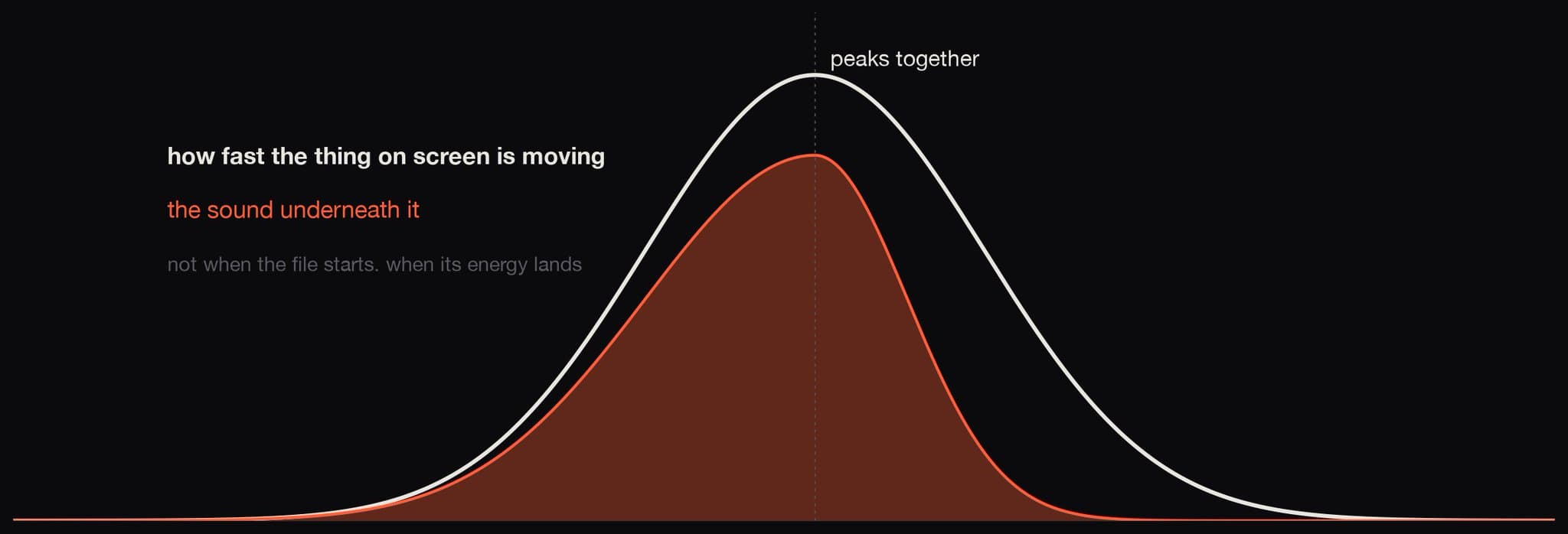
Timing matters more than people think. The ear is a better judge of sync than the eye. A hit slightly early feels right. Slightly late sounds bad, and you can't say why, it just does. Real contact never happens after you see it, right? Your ear knows that even when you don't.
Premium is dark
Low sounds read expensive. Bright sounds read cheap. Almost every sound-design sin in tech videos lives in one harsh bright zone your ear genuinely hates sitting in.
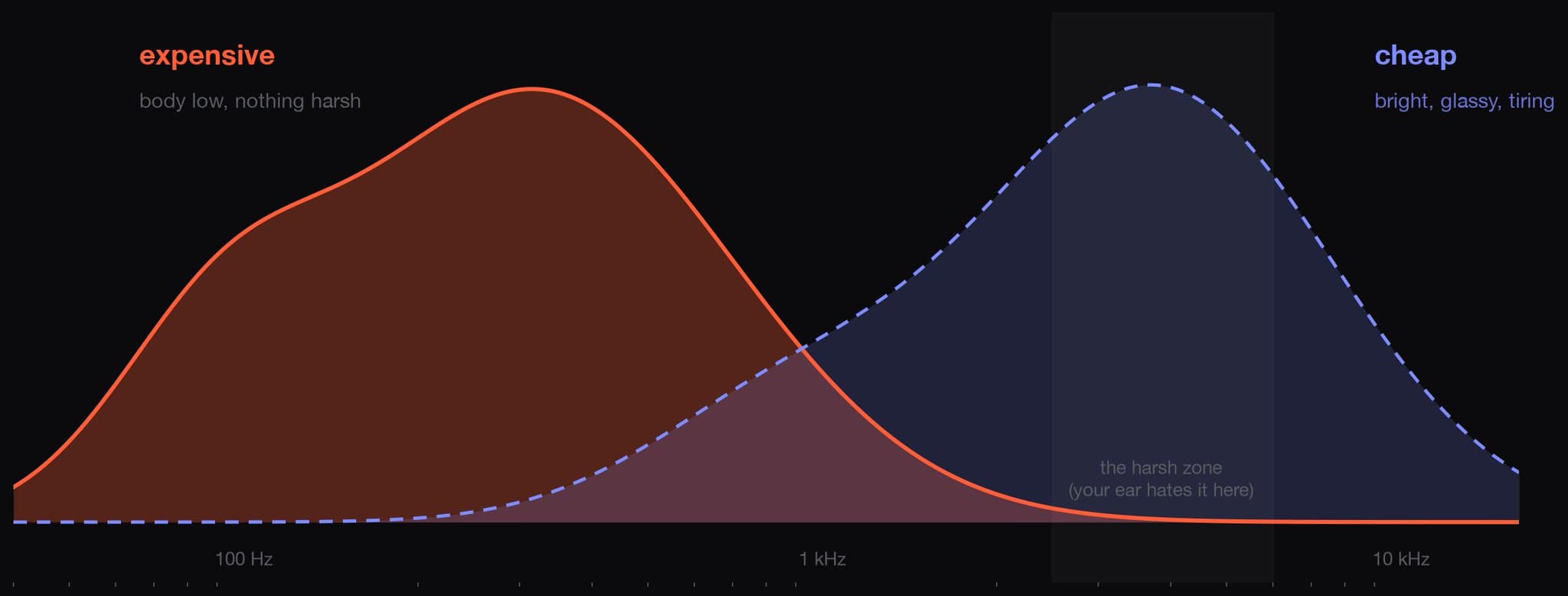
So typing isn't a keyboard click. It's a felted thump, like fingers on wood through cloth. A notification isn't a bell. It's a low muted marimba note. When we want a sound to carry more weight, we pitch it down. Pitch anything up too far and it reads like a toy, no matter how good the source was.
Think about the things in real life that sound low: heavy doors, good cars, thick books closing. Now think about what sounds bright: plastic, coins, alarms. Your ear already has taste. We just follow it.
Nothing real repeats perfectly
Familiarity also means imperfection. When text types on letter by letter, the lazy move is playing the same sample on a perfect grid. Your ear calls the bluff instantly. Nothing in the real world repeats identically, so a perfect repeat reads as fake.
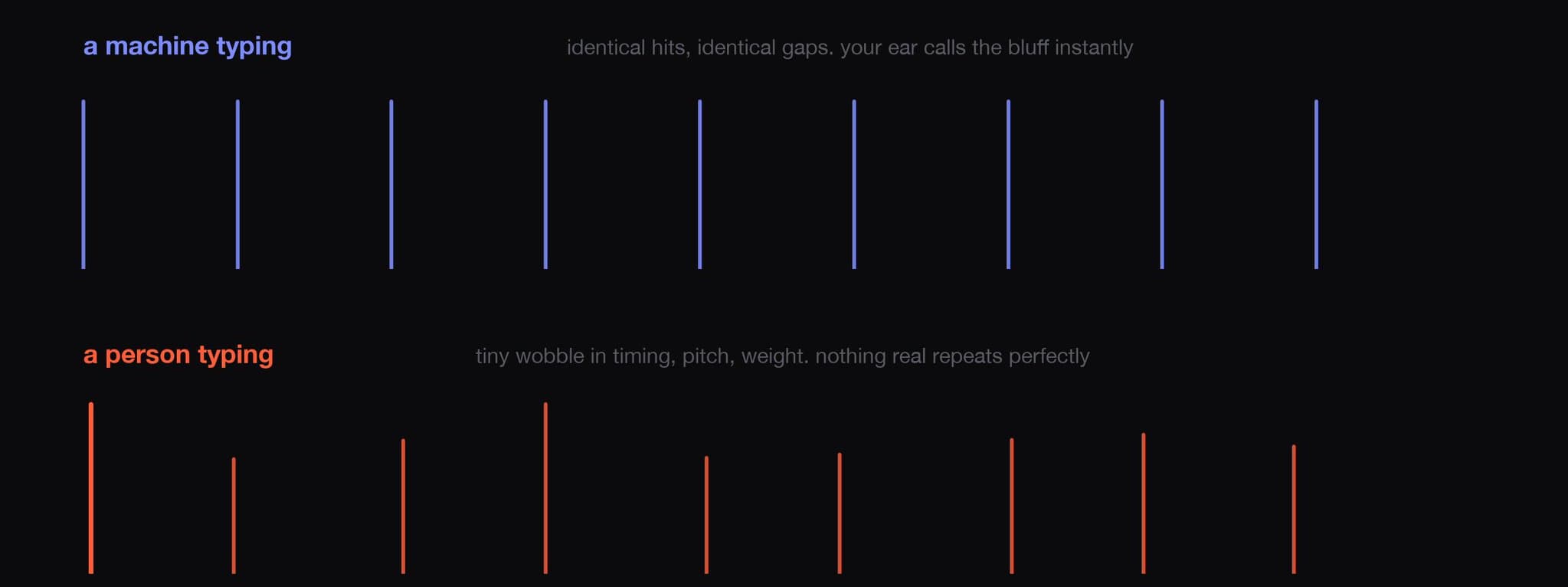
So repetition gets treated as one gesture, humanized: tiny wobble in timing, pitch, and weight on every hit, one accent where the gesture starts or lands. Same with consistency. The same object always makes the same sound, every time it appears. Re-rolling a new sound for the same button is like a movie recasting an actor mid-scene. The ear stops believing the world.
Silence is a design decision
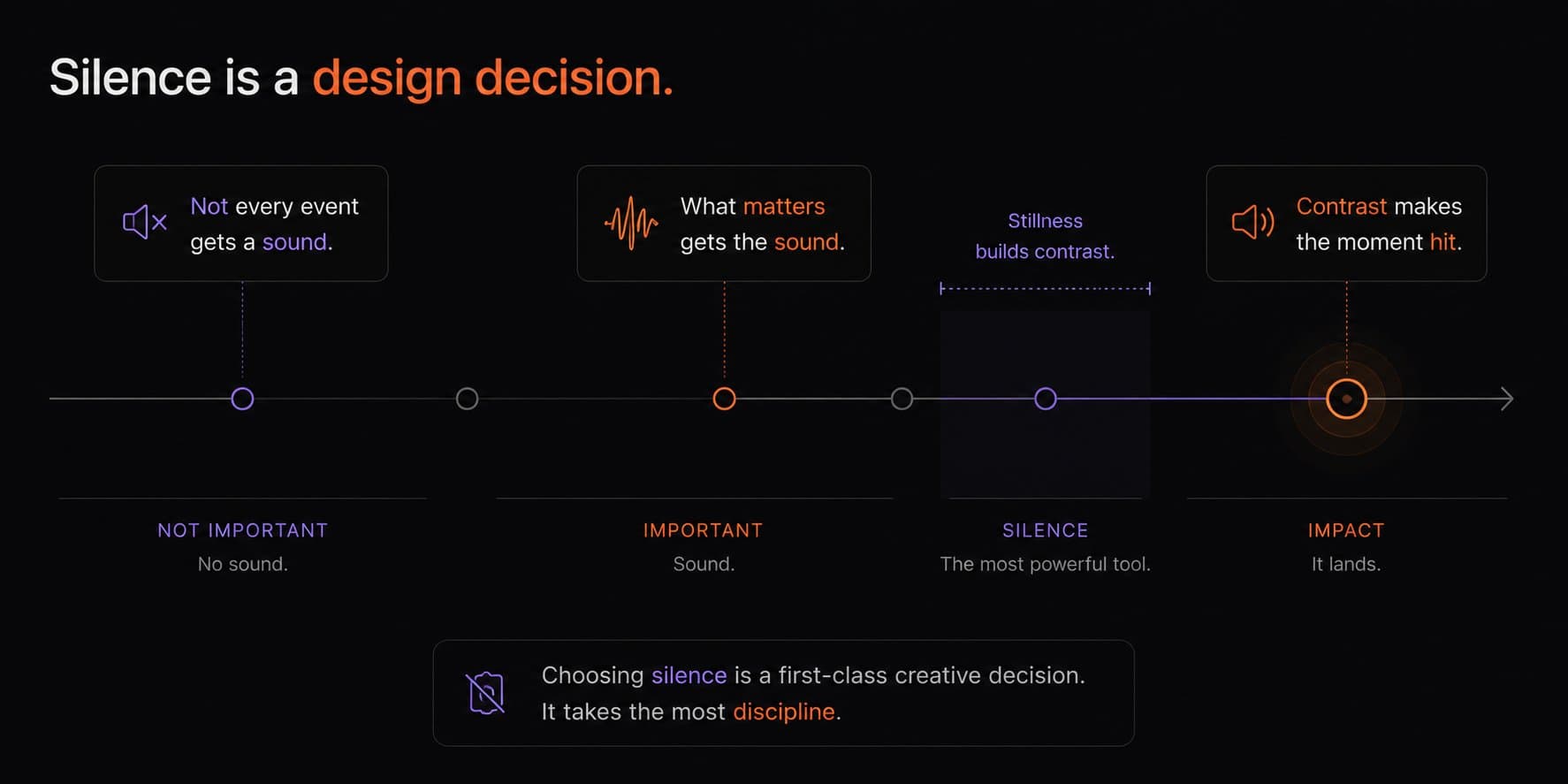
The loudest tool we have is not playing anything.
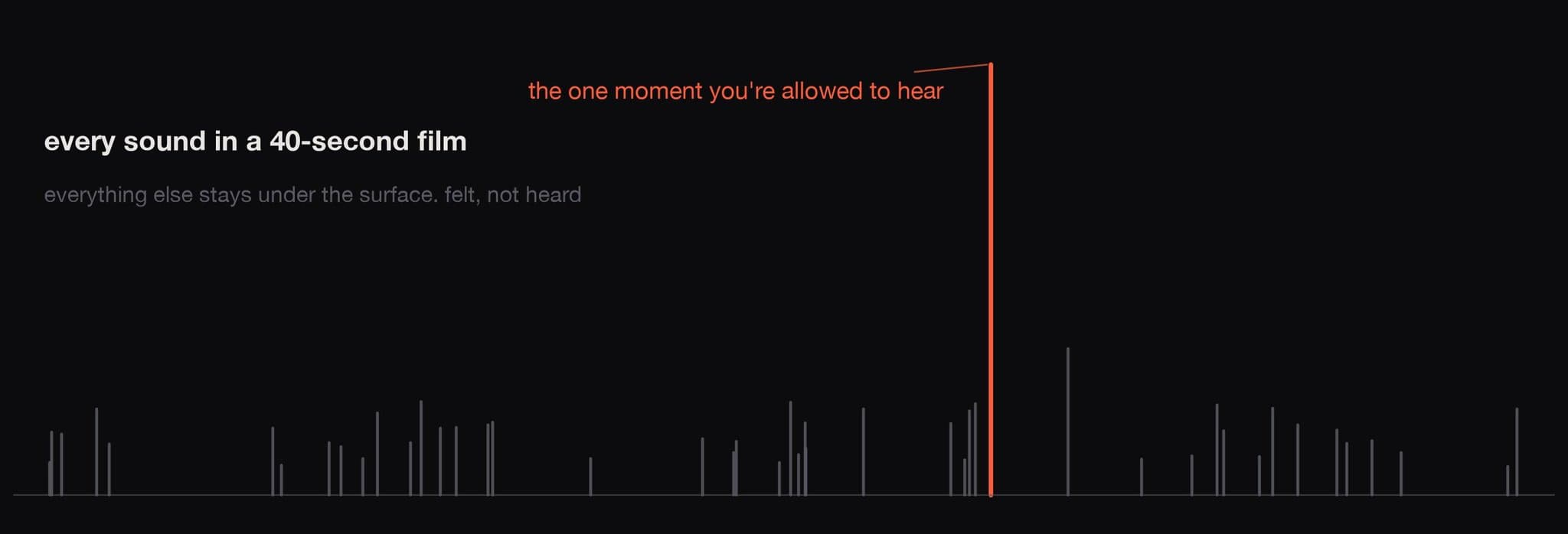
An event you're not looking at doesn't get a sound. A moment that doesn't matter doesn't get a sound. And the stillest beat in the film sits directly before the biggest one. That contrast is the entire reason the big moment lands. If everything makes noise, nothing does.
Saying "no sound here" is a first-class creative decision, and honestly the one that takes the most discipline.
Sound creates memory
People are bad at remembering details.
They're very good at remembering feelings.
You probably don't remember the exact animation curve of a product you used yesterday. You don't remember how many milliseconds the menu took to open. You don't remember the exact frequency of the sound that played when something completed.
But you remember that it felt fast.
Or satisfying.
Or expensive.
Or cheap.
That's where sound becomes more than feedback.
It becomes part of the memory of the product.
The best examples are obvious once you think about them. You can hear certain brands without seeing them. A startup sound, a notification, a console turning on, the beginning of a film.
A tiny piece of audio can carry years of familiarity.
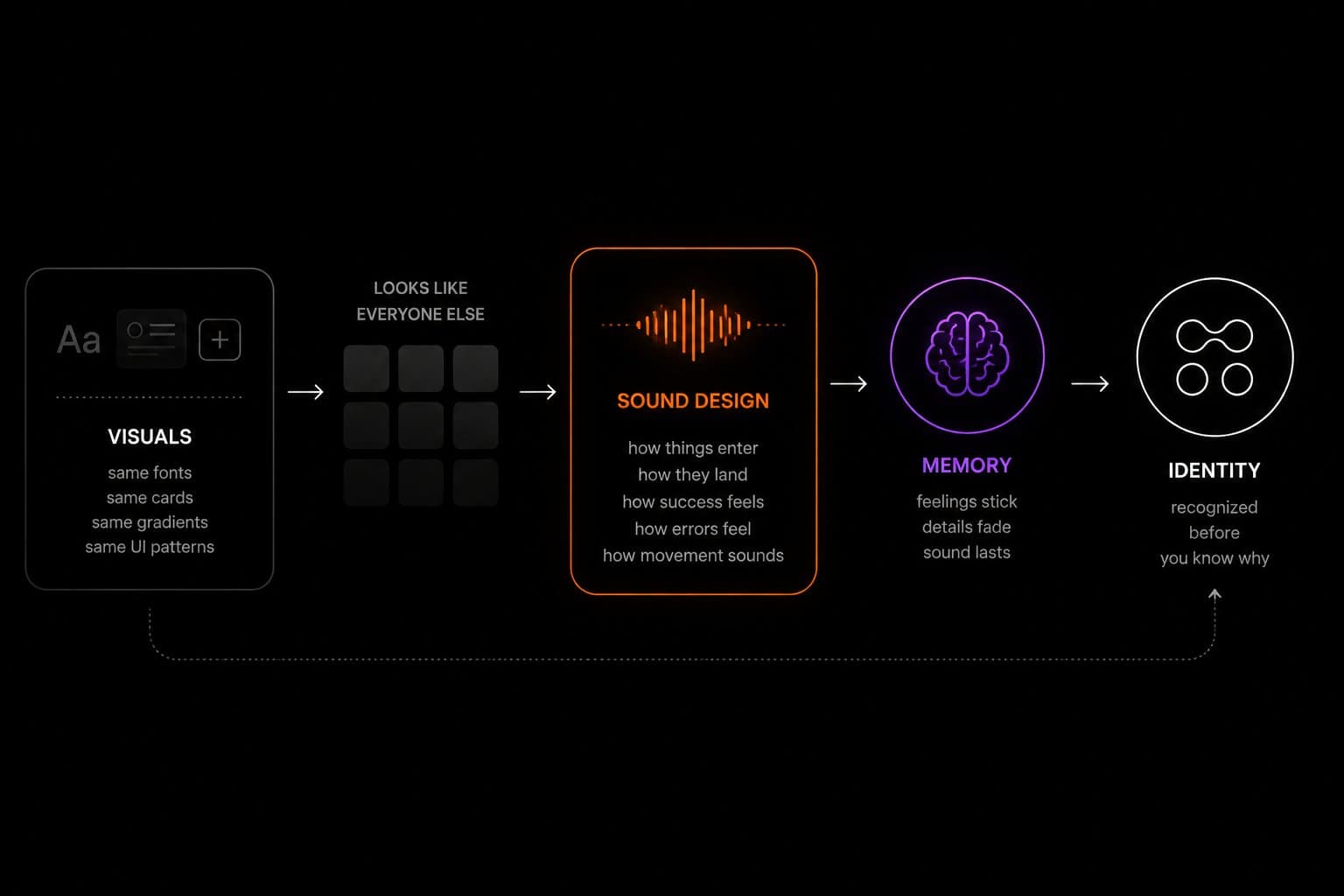
And that matters because products are increasingly starting to look alike.
The same fonts. The same cards. The same gradients. The same UI patterns.
Sound is one of the few dimensions that still has a huge amount of unexplored identity inside it.
Not a branded jingle slapped onto the end.
A system.
How things enter.
How they land.
How success feels.
How errors feel.
How movement itself sounds.
Do that consistently enough and people start recognizing the product before they consciously know why.
Why we care so much
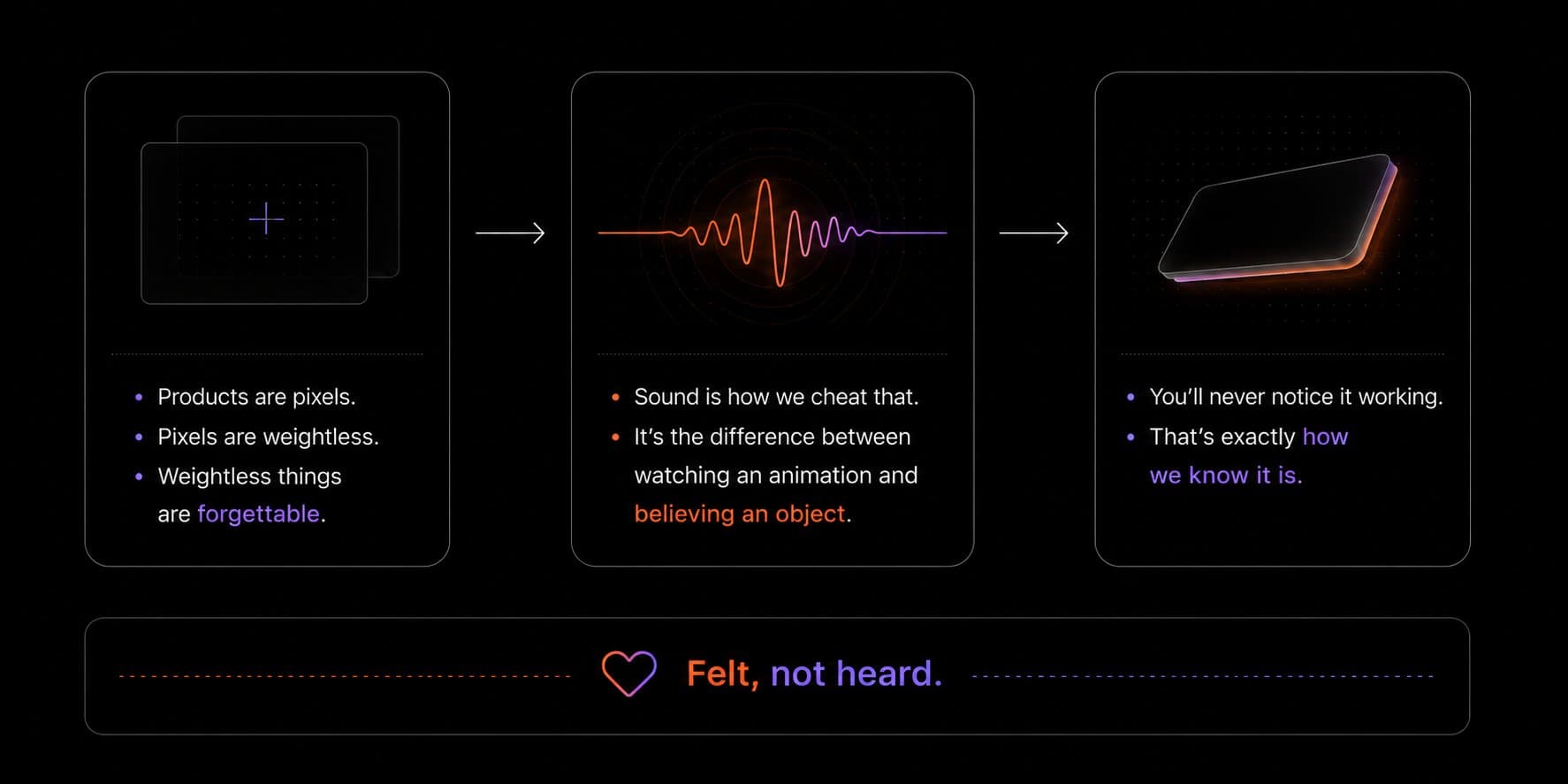
Motion makes films for products. Products are pixels. Pixels are weightless, and weightless things are forgettable. Sound is how we cheat that. It's the difference between watching an animation and believing an object. You'll never notice it working. That's exactly how we know it is.
Felt, not heard.